

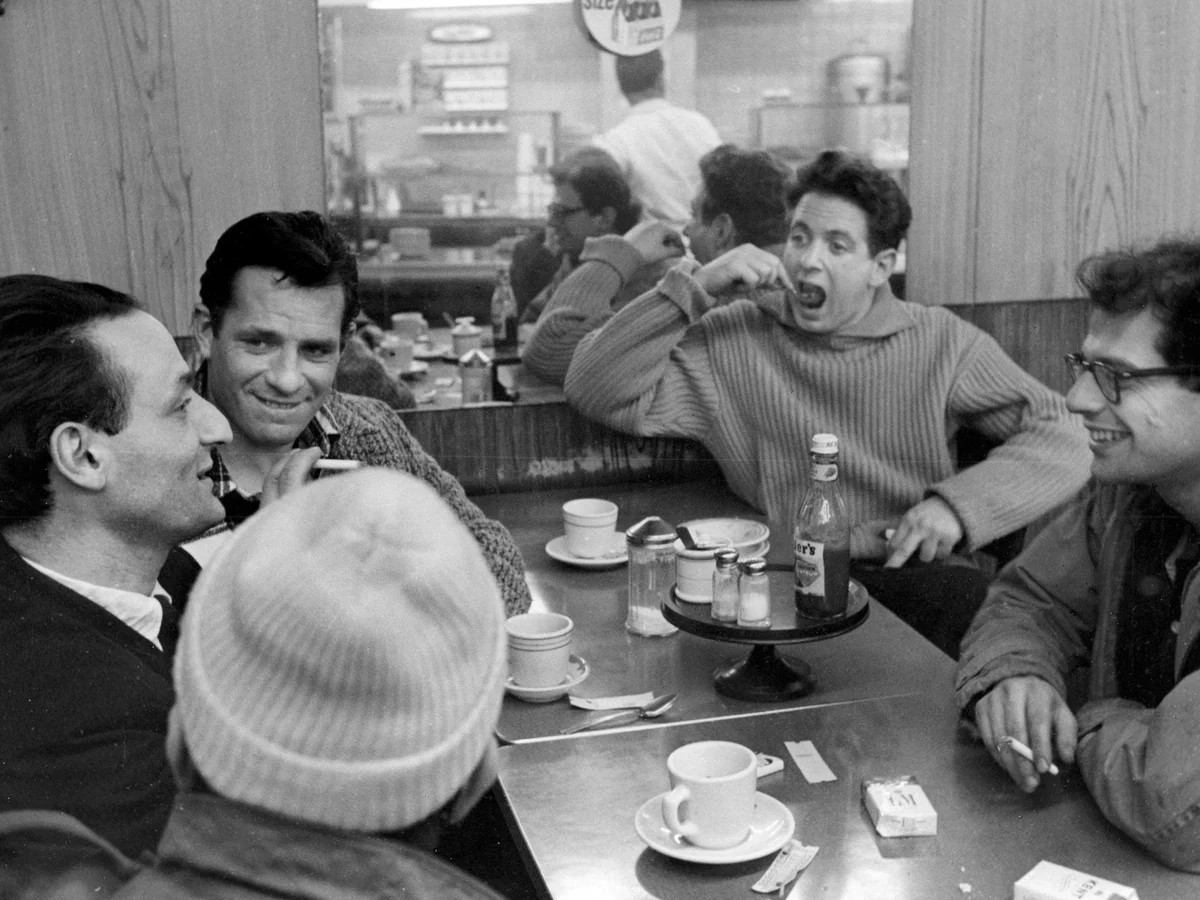
How the Beats inspired and foreshadowed the rise and fall of the Hippie Movement
We are living in a spiritually confused and politically terrifying time. We are cut off from religion, community, and ecology.
These sentences could easily be heard today, but they could also just as easily be heard in San Francisco among certain anarchist-leaning poetical circles during the 1950s, the members of whom we would now refer to as the Beat Generation.
The Beat Generation were best-sellers (or, more accurately, a couple of writers were: Jack Kerouac and Allen Ginsberg), and they had an enormous cultural impact, most notably in shaping several cultural touchpoints for the Hippies who would come after them. Hippies, of course, have existed in some form since the mid-to-late 1960s, with their cultural touchpoints remaining in many ways the same. One such way is an interest in Asian culture and religion. Yoga is now entirely mainstream in the West, we still giggle over the Kama Sutra, and travelling around Asia to find oneself is now more-or-less a middle-class rite of passage.
How, then, did the Beats actually approach the East? And how, in the popular imagination, are the Beats conceived? Do they perhaps have more to communicate about Western interaction with Asian religion than we might at first imagine?
It is first important to situate the Beats in their specific context: the 1950s were a time of post-war affluence but equally post-war anxiety, and San Francisco – where most of them were based – was not yet a tech hellscape, instead known as a liberal and cultural hotspot (although it was still conservative compared to what would come later in the Haight-Ashbury neighbourhood during the late 60s). San Francisco also had (as it still does) strong connections with the University of California, Berkeley, which is just across the bay. It was, in short, an intellectually and culturally stimulating place to be during an exciting period of prosperity. However, as with all periods of affluence, the affluence in question refers to the middle classes, and with this affluence came society’s ossification into a very particular model of consumer capitalism that centred around the nuclear family.
The Beats’ resistance to this model is what enables them to retain their cultural capital today. In the sixteenth episode of Gilmore Girls’ second season, the bad-boy-who-reads, Jess, expresses his admiration for the Beat Generation, who, in his words, ‘believed in […] stirring things up.’ Paris, an uptight-high-achiever figure, argues instead that they are ‘self-indulgent’ and says she has ‘one word for Jack Kerouac: edit.’ This summarises quite well the existing perception of the Beats. Paris criticises spontaneous prose, while Jess draws attention to their wildness. No reference is made to their influences (of course, you wouldn’t expect a nuanced discussion in a thirty-second transition scene, but it is striking how neatly the writers of the show sum up what is often quite a circular debate). It is easily forgotten how well-read the Beats really were.
All of the Beats in the San Francisco scene of the mid-50s (where it all began, with the Six Gallery poetry reading in 1955) were interested to some extent in Asian religion, most notably Japanese Zen Buddhism. Zen Buddhism, as interpreted by D. T. Suzuki (who had a large part in popularising Zen in the West), is an ecological and anti-authoritarian religion that sits happily alongside the philosophy of early American writers such as Whitman, Thoreau and Emerson – all of whom acted as inspiration for the Beats. This idea of Eastern religion stuck and continues, I would argue, in Hippiedom today. Kerouac would read the Diamond Sutra every day, Gary Snyder was doing postgraduate study at Berkeley on Chinese and Japanese language and culture, Allen Ginsberg had an interest in Indian religion, and Philip Whalen shared Kerouac and Snyder’s interest in Zen. Both Snyder and Whalen would go on to be practising Zen Buddhists. Kerouac and Ginsberg’s engagement would be more haphazard but more influential, neither of them committing to serious study or any single path.
While Snyder and Whalen’s poetry was far less well-known but arguably more thoughtfully involved with Buddhism and Hinduism, both Kerouac and Ginsberg’s books on Asian religion were hugely popular and, while haphazard, contain a humanity and vulnerability that illuminates the quest of the Hippie and interest in Asian religion in the West generally. They are looking for alternatives to a secularised society in which money and power are privileged over all else. What they find in these alternatives is revealing. I would argue that at no point, even though they are said to have largely inspired The Hippie Trail from Europe to Asia, which was undertaken by Western youths throughout the 1960s and 1970s, did the Beat Generation indicate that enlightenment was to be found in the East.
The blurb of my copy of Kerouac’s hugely influential 1958 novel, The Dharma Bums, describes the book as a ‘cry for a “great rucksack revolution” in which the country’s youth would throw off the everyday, take to the open road and live the Buddhist way.’ But the book is not ebullient; it is sad. It is as much a story about an alcoholic losing the fight as anything else. A scene in which spiritual-leader Japhy Ryder takes the protagonist mountain-climbing is indicative: at the peak of the Matterhorn, Japhy emits a cry somewhat like the one we might imagine the blurb to be describing, while our narrator Ray sits huddled in a crevice just below the mountain’s peak, too tired to go any farther up. This is where the novel’s poetry comes from: its admission of its own failure. From the beginning of the book, there is disillusionment. It begins with the narrator’s admission that ‘[back] then I really believed in the reality of charity and kindness and humility and zeal and neutral tranquillity and wisdom and ecstasy.’ Kerouac’s narrator is always already disillusioned. The arc of the Hippie generation from optimism to malaise is already predicted in the first pages of the book that would inspire them.
Another major influence on The Hippie Trail and the Hippies more generally was Ginsberg’s 1962-63 visit to India and Japan and the book of poetry (Planet News) and journals that resulted from it. From the journals and poetry, the impression one gets is that Ginsberg spent more time thinking about sex and scoffing at whatever drugs he could get his hands on than thoughtfully engaging in Asian culture. Planet News ends not with an endorsement of the enlightenment to be found in Asia, but rather an admission: ‘I am / a mass of sores and worms / & baldness & belly & smell / I am false.’ In Eastern religion, he finds a legitimisation of this feeling of falseness, but not a cure. The story of Ginsberg’s trip to India is revealing in many ways. It illuminates one central reason for the increasing popularity of the Eastern turn: a way of running away from the self. And as with all such journeys, they inevitably end when the runner realises that in all their days or weeks or years of sprinting, they haven’t left the starting block.
Not much has changed. Nowadays, middle-class youths such as myself are marched through Southeast Asia like our parents through Ikea back home, politely shown a highlight reel: here is our country, here is our people, here is our religion, here is our culture. Ah, yes, we say. And then back on the plane with a new cycle of anecdotes about getting smashed in hostels and the beauty of the mountains and the dignity of the simple life. The Call of the East has been answered – we went, we saw, we milled about. Ginsberg bombed out in Benares, and thinking about Blake isn’t all that different. Holy holy holy, he says. Yeah, right, we think.
The Dharma Bums and Planet News are ultimately books about aiming for the stars and falling flat on your face. They narrate the deeply human failure of the Hippie Dream ten years before it was born. A dream always already fallen apart.
If you enjoyed this article, you may also like – In Defence of Banned Books
