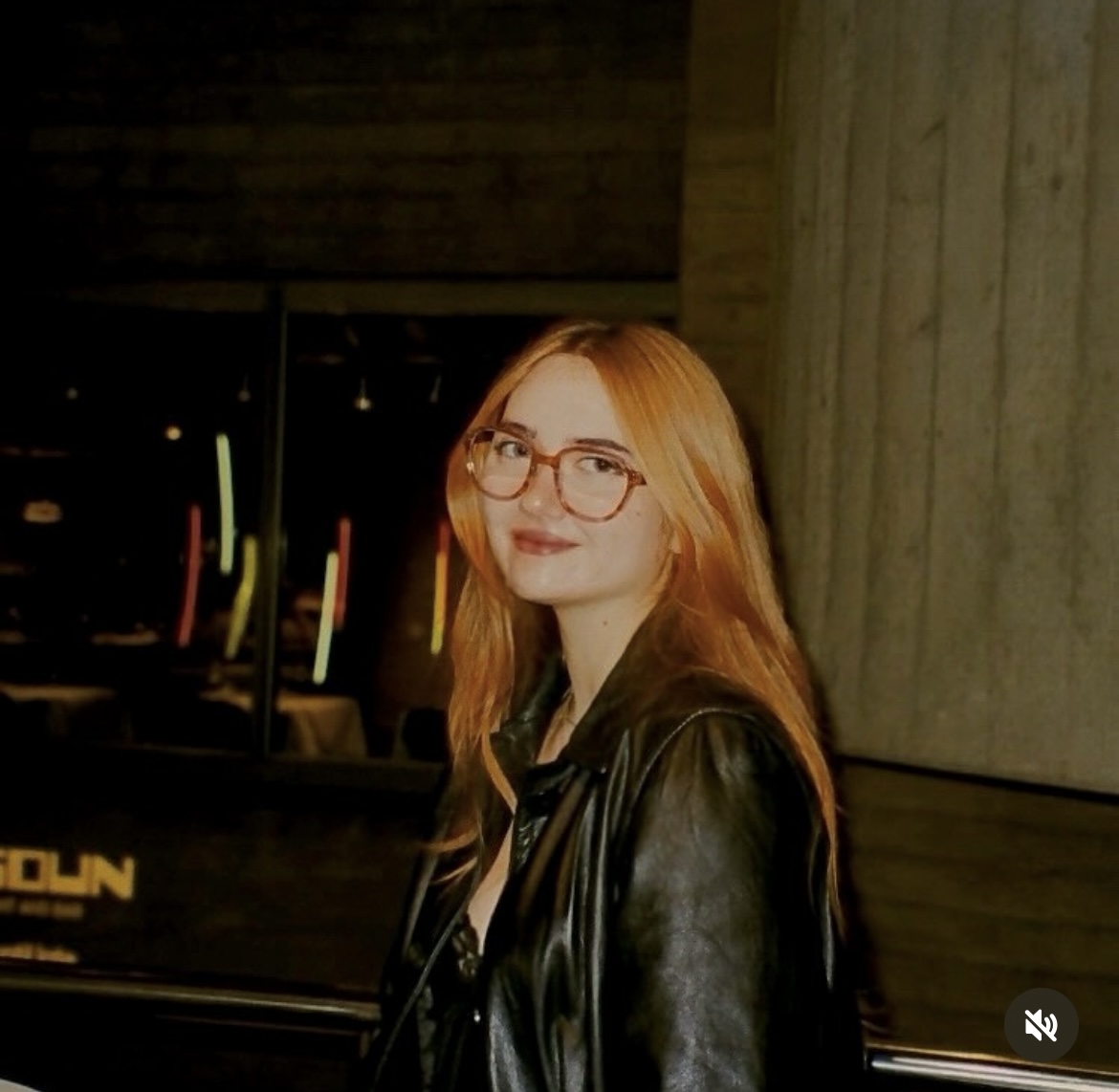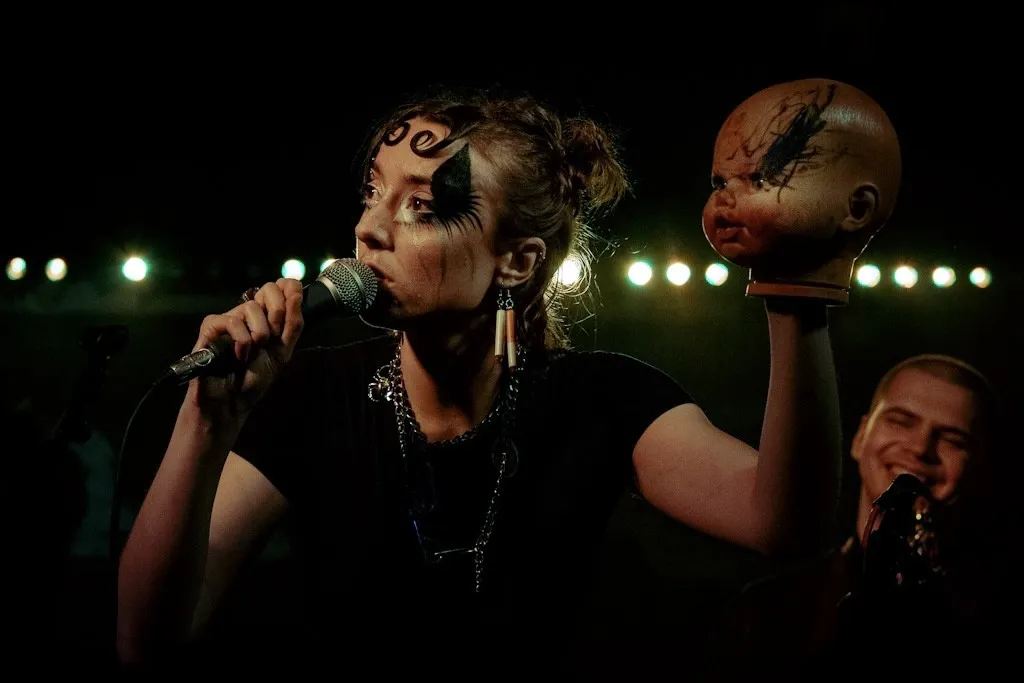
Bella Artois is a five-piece made up of Bella (rhythm guitar, singer), Vi (bass), James (saxophone), Daniel (guitar), and Olly (drums). We interviewed the band just before they played a charity gig at the IDS Bar. We managed to receive answers on queerness, music and, of course, the schism between the Orthodox and Roman church.
How did you form as a band?
Vi: So, it was the mid-1980s, I was working as a waiter on a cruise ship, and we were attacked by pirates. Bella was in charge of this sort of crew of Mediterranean pirates. They had been raiding ships in the area for a while. They saw me and they were like “Gay?”
Bella: Can you play bass?
Vi: And I was like “Yeah” and we formed a group, then we met James at college.
James: A couple years later, we went to college.
Bella: Daniel’s quite a new edition.
Daniel: We suddenly time jumped to 2025 at the Shacklewell Arms, and you just turned up, I was in the middle of making soup.
Vi: It was mostly the soup that got them in to be honest.
Daniel: I didn’t bring any of it to the gig, but they just knew it was that good.
Olly: Umm, I guess I joined…
Bella: Say something witty!
Olly: I think I joined a couple years ago. (Bella: how did we meet? Daniel: I don’t remember not knowing you.) I think I met you at a gig years ago (Vi: Many moons hence.) In Angel? (Vi: In the era we don’t speak off.)
Bella: Me and Olly were once in a band in 1844. Neither of us are in that band anymore.
Are you just time travellers or just immortals?
Vi: We are just very old! There’s no travel and we are capable of death. We are just ancient, ancient beings.
Bella: Can I say Olly is technically the only one of us who isn’t a twat. The rest of us did meet at the BRIT School and then we found you…
Olly: You found me in the streets of London.
Vi: We met in a dark alleyway in Croydon in a back-alley hormone deal.
Daniel: That being said, the 1844 thing and the pirates did happen. It’s two truths and a lie.
As you are here playing a gig which is raising money for Just Like Us, why do you think it’s so important to play queer spaces?
James: This is the one question we can’t do a piss answer to.
Bella: For me, it’s always nice to play for a queer audience because I think there’s a kind of understanding there.
Daniel: As a queer artist, you can be an inspiration to other queer people in any capacity, even if they’re not artists, just seeing you express yourself in a way that you have pushed yourself to be able to do, then that can be very inspiring for other queer people. I think I’ve experienced that, looking at queer artists growing up. It’s just as important to do that for others.
Vi: Also, one of the other bands has a banjo.
Bella: That was the draw.
Vi: Of course, the B in LGBT stands for banjo.
Bella: Being serious for a moment, quite a lot of my songs are talking about ex-girlfriends and stuff, not in a very positive way. In a recent song I was like she can never find my G spot, she was really bad in bed and that kind of thing. There’s kind of a stereotype about lesbian relationships being this utopian, beautiful, like “oh wow it would be so much easier to date a woman.” I guess it’s just me saying that it’s just as bad; there are all of the same issues.
Vi: There’s just statistically less murder.
Bella: Exactly!
Vi: Emotionally there’s just as much.
Vi: Do you have any questions about the schism between the catholic and Orthodox churches?
What’s your opinion on it?
Vi: So basically, there becomes a split between the Greek speaking eastern side and Latin speaking western side, as that’s why you have the Cyrillic alphabet in Russia and all that. The Byzantines are the origins of what is now the eastern Orthodox church. That’s the thing, the Romans felt really bad ‘cause they all converted to Christianity, and they were like “ooh we kinda killed Jesus” so they have to do some heavy-duty PR. They throw all the Jewish people under the bus and go “that was them”. We’ve got the pope now, so it’s not just Rome, it’s the pope in Rome. I think there’s 1 and ½ popes per square mile in Vatican City.
James: What do you mean?
Vi: Cause it’s less than a square mile inside.
I have heard there is a Queer DIY (Do It Yourself) Scene in London, do you think it exists?
Vi: The electronic music scene is super dominated by trans people and queer people in general, as it’s music you can make by yourself in your bedroom, so it’s almost impossible to gatekeep. In DJing and club culture there’s a whole sort of DIY club scene. I think there’s definitely been a wave of queer bands but it’s trickier to do; it’s expensive to set up a band and there’s not a lot of money in gigging a lot of the time.
Daniel: I think London gigs in general are DIY. You get a lot of people setting up their own gigs because promoters prove themselves to be untrustworthy; you do get some issues on that side of things. I think people have started to do it; there’s been a big wave of it.
Vi: Especially post-Covid as so many venues who were the bridge between smaller time stuff and bigger time stuff have effectively closed down.
Daniel: On the queer side of things, we played a gig for a friend’s top-surgery. I think that sort of thing tends to be set up a lot by queer artists. You get proper ticketed gigs in that sense. You do also get a lot of fundraisers in that sort of vein, just trying to help people.
James: To add on to what Daniel’s saying, generally speaking, when you look at a lot of London music scenes at this level, often the communities can be sort of a bit cut-throat in London. “To get me on the next level, I’m only going to talk to the acts that if I talk to them, they might put me on their line-up or whatever.” Whereas I’ve noticed generally for the queer music scene it is just a bit more like “I’m just here to have a good time”, this is a safe space where I can hang out and chat with nice people. It’s a good vibe. Obviously, all of us would like to be making a living off what we are doing but it’s a much nicer pace, it’s a much nicer community of people.
Daniel: In the media and government, you do have a push against queerness. When that happens, you do get more queer art, and it tends to be DIY for the reasons we said. Again, when you have terrible things going on in the world, sometimes you have got to fight back and sometimes all you can do, in any given scenario, is just to refuse and just continue to be yourself and just to make beautiful art in the face of that terror.
Bella: Make your own spaces.
James: What’s the phrase ‘joy is an act of rebellion’?
In the very room we were speaking in, the band had recorded parts for their new EP ‘At Your Cervix’ which will hopefully be released in the early summer. In the meantime, Bella Artois regularly do gigs in both London and Brighton.
Interview conducted by Pluto Williams and Fi Muncaster
Photo from loudwomen.org
If you enjoyed this article, you may also like Nostalgic Indie Rock Finds a Modern Vessel in Florentenes