

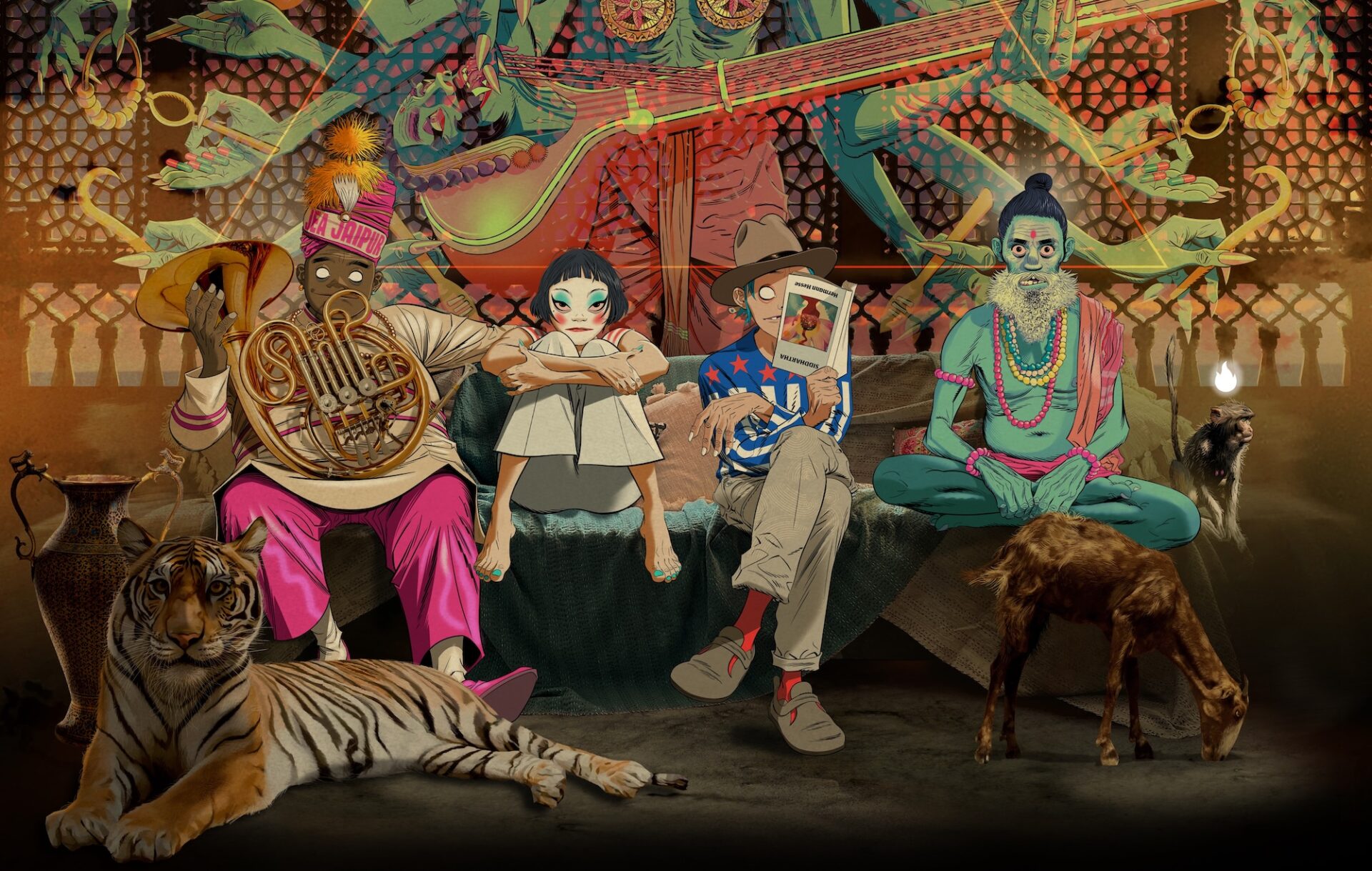
After a few projects that felt deliberately loose, Gorillaz return to form with The Mountain. The opener, ‘The Mountain’, is instantly captivating. Bouncing percussion and a droning sitar line pull you in and slowly build; it feels elegant and intentional, establishing the album’s sonic identity straight away.
‘The Moon Cave’ keeps that momentum going, evolving from sweeping strings into a funky disco anthem. Damon Albarn’s vocals sit right at the front of the mix, but rather than overpowering the track, they glide through it. From here, ‘The Happy Dictator’ moves in a more danceable direction, with lyrics that allude to themes of authoritarianism, influenced by Albarn’s time in Turkmenistan. The backing vocals recall ‘Don’t Get Lost in Heaven’ from Demon Days, yet the track takes them in a completely different direction.
Next, ‘The Hardest Thing’ shifts the mood, tackling life and death through the lens of letting someone go. I find the climax of the song really moving. “‘Orange Country’ takes that emotional weight and reframes it through a playful, whistle-led hook, threaded with Indian flourishes that keep the album’s cohesion intact. Not every transition lands perfectly, though. “‘The God of Lying’ lands less seamlessly than earlier shifts, but its shadowy production and feature from Joe Talbot of IDLES makes it quite memorable.
‘The Empty Dream Machine’ does a better job of merging the sitar textures with the established club energy, while it has a touching verse from the late Black Thought, an example of Albarn’s intention to use this release to honour artists who have passed. ‘The Manifesto’ is another clear highlight, with its first half embracing Spanish-language, chantable hooks in a way that feels reminiscent of Bad Bunny’s approach, before pivoting into a punchy rhythmic section.
As the record moves into its final stretch, the theme of unity becomes clearer. ‘Damascus’ leans heavily into Arabic influences, blending them into a vibrant, club-ready structure. Despite its ambition, ‘The Shadowy Light’ functions as a better example of that cultural fusion working at its strongest, as it more clearly lays its influences naturally within the mix. The psychedelic atmosphere shines here, giving the track a drifting, almost hypnotic feel that remains sonically cohesive with the rest of the album.
‘The Sweet Prince’ follows with a blissful calm. Light guitars, a bouncy bassline and a muted, reverbed chorus combine into one of the album’s most tranquil moments. Finally, ‘The Sad God’ closes the album, tying many of its central themes together and touching on loss, longing, and reflection. With an enchanting chorus, the song finally fades into a droning, melancholic haze.
Culturally, the album’s impact runs deep. The involvement of the Bangash brothers, sons of Ustad Amjad Ali Khan, alongside Anoushka Shankar, daughter of Ravi Shankar, carries real significance. Indian classical instrumentation has rarely occupied this much space in mainstream alternative music since George Harrison helped introduce it to Western audiences in the 60’s.
Furthermore, the multilingual approach, weaving English, Arabic, Spanish, Hindi and Yoruba, gives the project a genuinely universal feel. Being South Asian myself, hearing elements of such diverse musical heritage being woven so naturally into a band that has defined so much of modern alternative music is honestly so powerful. Overall, The Mountain feels thoughtful, cohesive and intentional, a true return to form and a standout release of the band’s already legendary catalogue.
Another article you may enjoy – https://thebadgeronline.com/2026/03/were-not-having-a-wuthering-heights-spring/
