

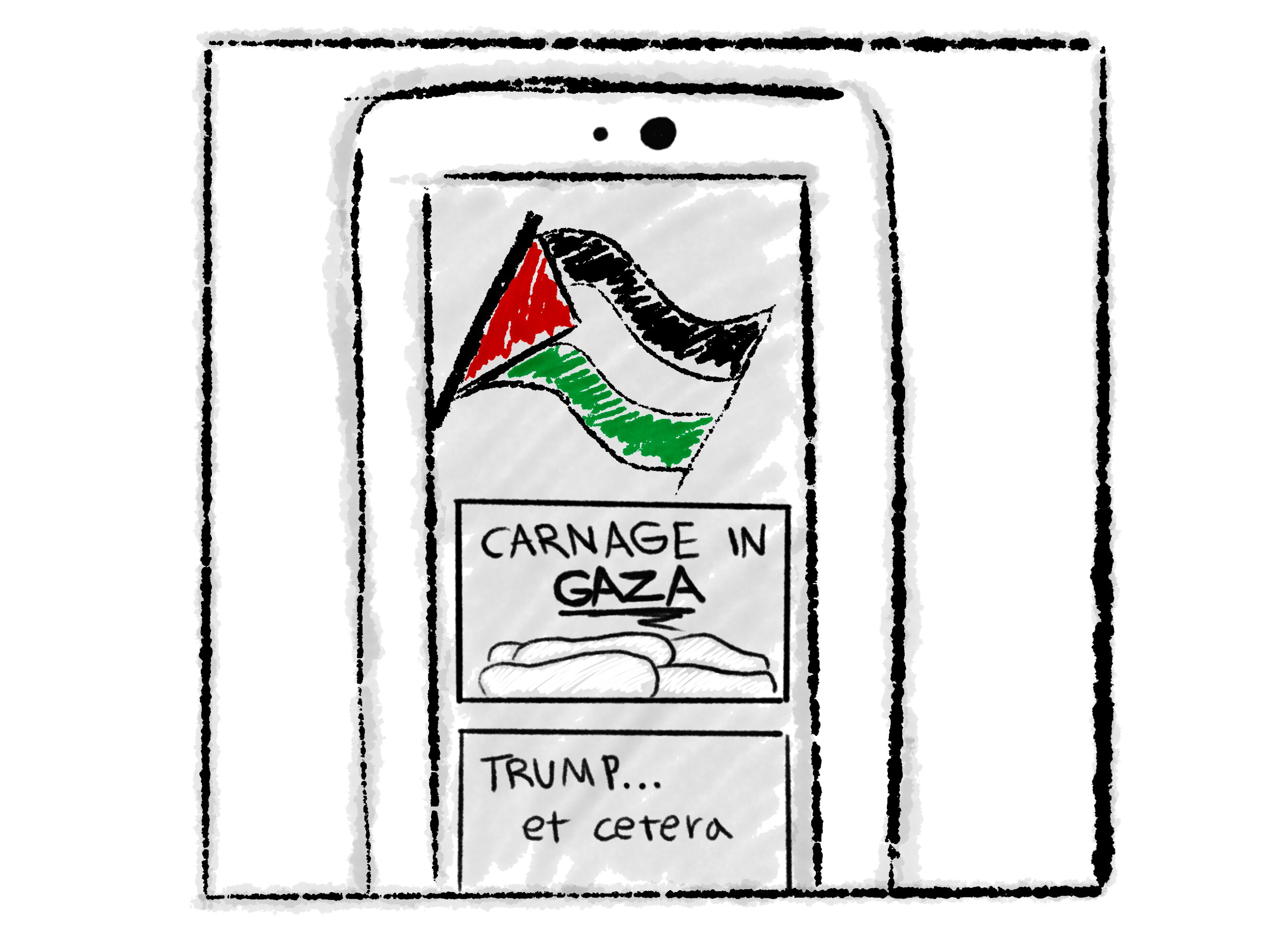
Is it staying informed or staying indoctrinated? On how the media we are consuming online is always politically motivated.
On 26 December, UN human rights experts expressed concern about the treatment of pro-Palestinian activists who had participated in a hunger strike throughout December, which continues into January 2026. The activists were imprisoned on charges in connection with Palestine Action, the group proscribed as a terrorist organisation, under the Terrorism Act 2000, by the UK government.
Two of the protesters imprisoned in HMP Bronzefield, Qesser Zuhrah and Amu Gib, began their hunger strike (which had lasted 48 days at the time of writing) in November. Friends and family have repeatedly called on David Lammy, the Secretary of State for Justice and Lord Chancellor, to communicate with the protestors and end their imprisonment, where Zuhrah was allegedly being denied critical medical attention, according to testimony from friends and family. In the later days of the strike, MPs including Zarah Sultana (Independent) and Jenny Jones (Green) joined a protest outside the prison until Zuhrah, who had become critically ill, was taken to hospital to receive urgent care.
Despite the participation of MPs in the mainstream like Zarah Sultana, researchers at LSE have found that, since the beginning of the hunger strikes, British mainstream newspapers have only covered the hunger strikers a total of 12 times. However, this lack of coverage is not new. Studies found that British press coverage of the IRA hunger strikes became increasingly limited over time, most notably Bobby Sands, who died after refusing food for 66 days following Thatcher’s policy of refusing to ‘negotiate with terrorists’. The LSE study describes it as an editorial decision that limited activists’ voices.
So are we really in control of the media we consume? Or has the very act of being denied news become the news itself?
In some aspects, compared with media coverage of previous wars, we certainly are more in control – we now have constant, immediate access to issues around the world. Videos and photos of Israeli raids in the West Bank are uploaded as they are happening, allowing social media users to instantly react.
Social media has given a voice to those affected most: people living in the region. Palestinians are now able to show their personal experiences, allowing them to show what mainstream media hasn’t. Yet, while Israel continues to restrict foreign journalists’ access to Gaza, limiting independent reporting of the destruction within Palestine.
However, this mass coverage from social media has its own problems. The Reuters Institute Digital News report indicates that users are finding it increasingly difficult to confidently identify trustworthy news on social media as a result of AI, political skew and bad actors. In its 2025 report, audiences indicated that politicians have become a ‘concerning source of misinformation’. One example of this is the widely circulated claims that Hamas beheaded multiple children during the 7 October 2023 attack. These claims were further alleged by both US and Israeli officials on social media.
Despite these claims, investigations by Le Monde, CNN and Haaretz found that whilst children were killed by Hamas during the attack, they found no evidence to substantiate claims of beheadings, despite confirming that children were among those killed in the attack.
The conflict of ‘truth’ happening on our phones and across social media feeds is constantly evolving and all-encompassing. This constant exposure to violent content has also resulted in widespread disillusionment, where audiences are beginning to avoid interacting with the news altogether.
While social media has provided us with a feeling of omniscience, there is little ability to do anything material about what we are seeing.
This kind of ‘digital burnout’ has contributed to a loss of faith in the democratic process, and a rise in apathy and desensitisation towards what we are seeing graphic footage that once circulated on the dark web now routinely appears in mainstream social media feeds. What used to be innocent scrolling now comes with a content warning.
This is part of a broader issue with social media algorithms: the longer a user stays on the app, the more revenue it can generate. As a result, there has been a dramatic rise in ‘troll’ and disinformation accounts often structured to provoke engagement, sometimes at the expense of accuracy. Many of these accounts focus on political content specifically to create the most controversy and the most money.
On apps like X, a recent update allowing users to see the country or region of origin for accounts has revealed that many of these contentious accounts are operating from foreign countries, despite claiming otherwise. This revelation calls into question which foreign interference is influencing how we perceive political issues.
There has always been a fight for your attention on social media, but as this fight extends into mainstream, traditionally respected sources of news, who is really controlling our perception of conflict? And more frighteningly, what forces are shaping our perception of conflict?
Another article you may enjoy: https://thebadgeronline.com/2026/02/585000-fine-three-years-of-scrutiny-sussex-vs-the-office-for-students/
