

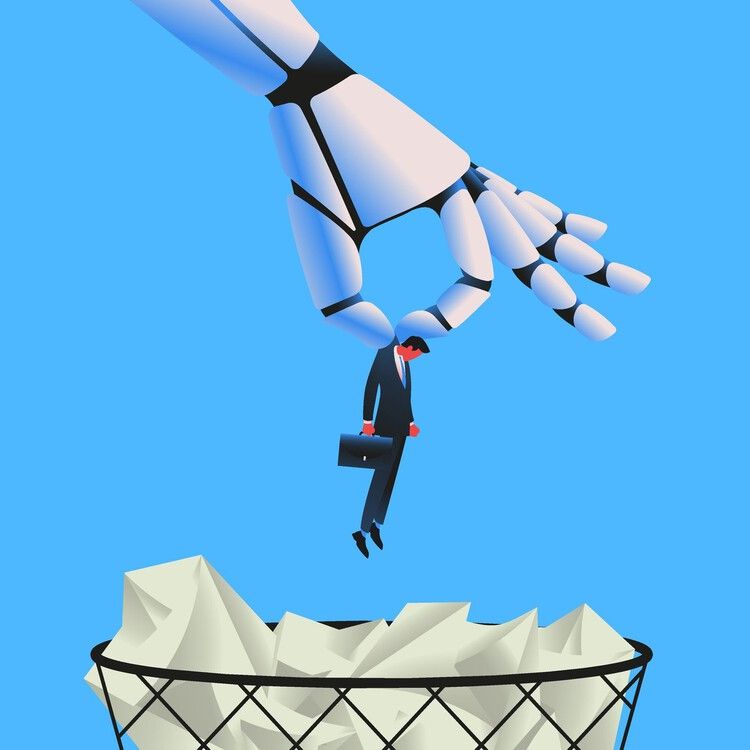
As a final year undergraduate, the future looks bleak. Graduate job openings have decreased by 8% over the past few years, and this trend appears to be growing. Everywhere we look, it seems that there is only one thing to blame for our lack of job prospects: Artificial Intelligence (AI). With articles titled “Will Robots take my Job?” and “UK graduates facing worst job market since 2018 amid rise of AI”, it’s easy to blame AI for the looming threat of unemployment. But is this true? Are we really at risk of being replaced?
It is undeniable that we are losing graduate jobs to automation. A recent study by King’s College London revealed that entry-level positions, which are most affected by AI, fell by 5.8% in 2025. Jobs most vulnerable to AI replacement involve repetitive, rule-based tasks, such as junior-level computer programming. Al can generate high-quality code in a matter of minutes, whereas it’d previously have taken a team of coders days or weeks to complete.
Administrative, secretarial, and assistant positions are facing similar fates. AI can now schedule meetings, take notes, manage calendars, scan and summarise documents, and even write reports for business decision-making. Unsurprisingly, for some companies, Al has become the employee of choice.
However, not every job can be replaced by AI. Roles requiring empathy and interpersonal skills, such as healthcare professionals and lawyers, remain less vulnerable. Similarly, jobs involving complex problem-solving or original creation, like those of scientists and artists, are more protected. After all, AI is not human; it cannot feel, relate to, or empathise as humans do. Whilst it is being used in these fields, its capabilities are not comparable to those of humans. For example, within healthcare, AI is increasingly used to analyse medical images, support diagnosis, and design personalised treatment plans. Yet, it cannot replicate doctors’ experience and decision-making, or the professional-patient interactions central to healthcare.
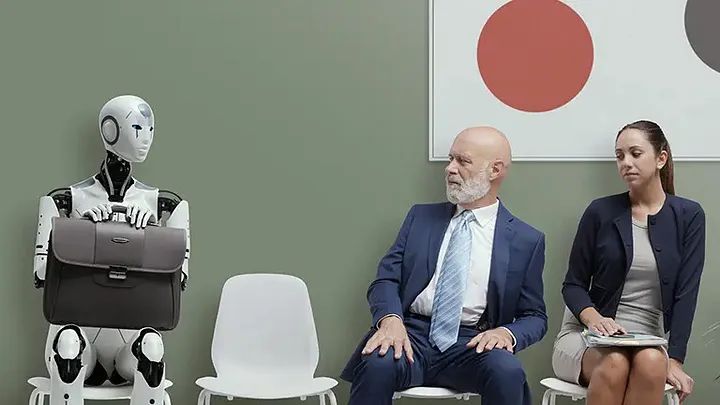
Moreover, corporate roles are not the only option for graduates. Interestingly, a May report by Resume Builder shows that 42% of Gen Z are pursuing blue-collar roles, indicating the increasing appeal of these jobs among Gen Z workers as reliance on AI grows and more entry-level corporate positions are automated. Indeed, AI is not capable of doing manual jobs. A 2024 McKinsey report estimates that the actual annual hires of trade-skilled workers between 2022 and 2032 could be 20 times higher than expected. Clearly, there isn’t a ‘graduate job crisis’ – it’s a corporate job crisis. There are, indeed, plenty of opportunities for those willing to reskill.
But what if you don’t want to re-skill? Not everyone possesses the physical or mental qualities for manual work. Is there still a chance in the white-collar world? Perhaps. AI’s automation isn’t necessarily the end. For centuries, technological advancements have been transforming the job market, creating new roles and increasing employment accessibility for people previously unable to work. Take the industrial sewing machine, for example. Hand sewing was once, and still is, a slow and meticulous task, requiring incredible skill and patience.
At the time, people feared that the sewing machine would put tailors out of jobs. Today, we know that it didn’t. Instead, it has aided them, making the craft faster, easier, and more accessible. As with the industrial sewing machine, there is no reason to expect AI advancements to be any different. In fact, AI is already creating new job opportunities.
Most notably, the rising popularity of large language models, such as ChatGPT, has spawned a new career: the Prompt Engineer, who tests prompts to ensure these models provide accurate, reliable, and ethical information. Experts predict that AI will create more roles, many of which we cannot yet imagine. Thus, for people who are reluctant to take on blue-collar jobs, new while-collar roles are emerging.
Given the current landscape, despite many changes and much uncertainty, I don’t believe that Al will put an entire graduating cohort out of jobs. Instead, the rise in AI will open just as many doors as it closes.
Another article you may enjoy: https://thebadgeronline.com/2025/11/meningitis/
