


The University of Sussex Vice-Chancellor, Sasha Roseneil, has spoken to The Badger after a series of difficult decisions on student services, society funding, and accommodation costs. In a wide-ranging interview, Roseneil described university financing and support for students in England as fundamentally broken, forcing universities into stark choices.
How Does Sussex University Decide How to Spend Its Budget?
“These are really difficult decisions, and right across the country (in other universities) very similar difficult decisions are being made every day,” she said. “We’ve got a broken funding system.” She was equally critical of student finance, arguing that “utterly inadequate maintenance loans” are intensifying pressure on students while limiting universities’ room to manoeuvre.
“If we have fewer students, we have less money to spend,” Roseneil said. Rather than concentrating cuts in one area, Sussex spreads reductions across departments and services so that “everywhere has to take… a little bit less money”. This approach, she argued, is intended to prevent any single part of the University from being hollowed out entirely, though it inevitably results in widespread pressure.
What Is The Impact on Society Funding and The SU?
Changes to student society funding, reported to be around a third less than previous years, have been among the most visible consequences of these financial pressures. Addressing the issue, Roseneil stressed that the Students’ Union (SU) is an autonomous organisation, funded by a block grant from the university that is calculated according to student numbers.
“When recruitment goes up or down, the funding rises or falls with the size of the student body,” she said, meaning the SU must “cut its cloth accordingly”, in much the same way as the university itself. While acknowledging the frustration this causes for students, Roseneil praised the “highly engaged and active” society culture at Sussex, describing it as central to student life.
She also suggested that student experience and reputation are closely linked to future recruitment, urging students to help project a positive image of the university at a time when attracting applicants has become increasingly competitive.
Why Did The West Slope Development Go Ahead?
Roseneil set out a detailed defence of the West Slope development, which has continued alongside reductions in some student-facing services. She pointed to the near-total withdrawal of government capital funding for universities, noting that institutions like Sussex have been expected to maintain and renew their estates without meaningful public support since the 1960s.
“The reality is that we have to make an operating surplus, an operating margin, in order to reinvest in the maintenance of our buildings and the construction of new ones,” she said.
According to Roseneil, Park Village, which West Slope replaced, was “completely unsustainable”, riddled with asbestos and damp, and built to such a low standard that refurbishment was not viable. “It had to go,” she said, adding that even in the 1970s it was already widely regarded as being in a poor state.
Are Accommodation Costs Fair?
Roseneil acknowledged that the replacement of Park Village with newer accommodation has driven up prices, a point of significant concern for students already struggling with the cost of living. However, she insisted this was unavoidable.
“We will not spend student fee income on subsidising student housing,” she said, arguing that this would be fundamentally unfair to the many students who commute or live off-campus. Tuition fees, she said, should be used to fund teaching and services that benefit all students, not to offset housing costs for some.
While Roseneil said the university aims to offer a range of price points and keep rents as low as possible, she acknowledged that this model severely limits how far prices can fall. She maintained, however, that on-campus accommodation at Sussex remains competitively priced when compared with private rentals in Brighton.
How Has The Encampment Influenced Policy?
Roseneil says that the university’s Socially Responsible Investment (SRI) policy has been significantly strengthened following the 2024 student encampment. An independent review on the matter resulted in a revised policy that has since been approved by the University Council and is now among the strongest in the sector.
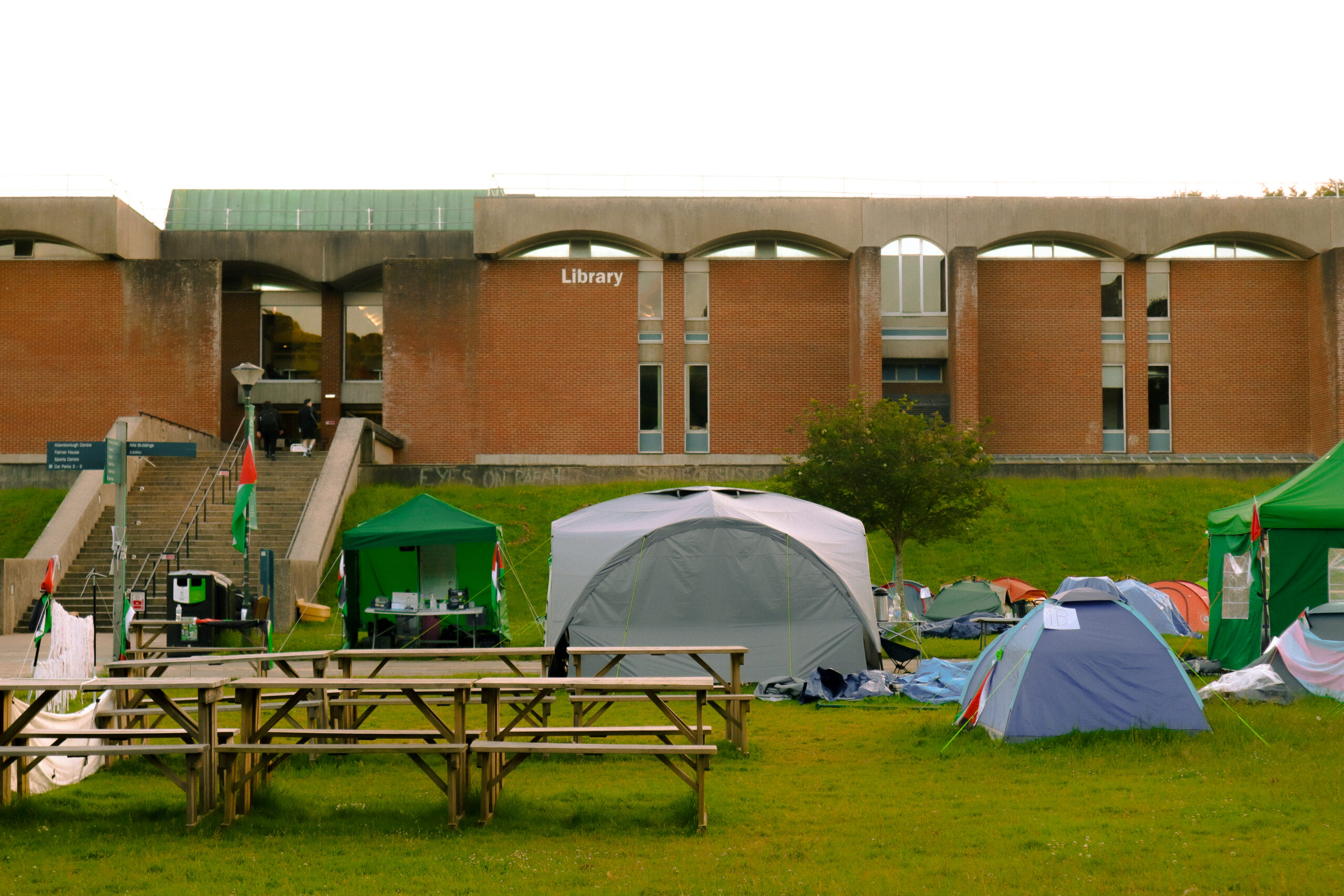
The updated framework introduces strict negative screening, excluding investment in organisations that derive more than 5% of their revenue from fossil fuels, armaments, or activities deemed illegal under international law. This includes companies involved in human rights or humanitarian law violations, occupation, apartheid, or genocide, as determined by a competent court.
While acknowledging that not all campaigners achieved everything that they had hoped for, Roseneil described the process as “highly deliberative” and rooted in sustained community engagement. She argued that this pressure ultimately resulted in a stronger and more defensible policy.
What’s In The Future for Sussex?
Beyond immediate financial pressures, Roseneil outlined the university’s longer-term vision through its new strategy, ‘Sussex 2035: Creating Progressive Futures – Flourishing, Sustainability, and Progress’. The plan seeks to position Sussex as a research-intensive yet student-centred institution.
She also highlighted Sussex’s expanding role in national higher education advocacy. The University is a founding partner, with Roseneil as co-chair, of ResearchPlus, a collaborative group of research-intensive universities launched in October. The initiative aims to give a stronger collective voice to institutions outside traditional mission groups, which Roseneil argued have been consistently under-represented in national policy debates.
ResearchPlus, she said, is intended to address deep structural problems in how research and innovation are funded across the UK, at a time when universities are being asked to deliver more with diminishing resources.
Taken together, Roseneil’s comments present a picture of a university operating under intense budget pressure, where decisions that directly affect students are shaped by a wider context. While many of these choices remain deeply contested on campus, the Vice-Chancellor mounted a strong defence that they reflect the best options available within a system she believes is no longer fit for purpose.
Another article you may enjoy: https://thebadgeronline.com/2026/02/graffiti-targeting-reform-society-appears-on-sussex-campus/