

In 1979, Margaret Thatcher became the UK’s first female Prime Minister, marking a historical shift in the British economic system. This change may be the culprit behind our dwindling mental health over the past four decades, leading to the mental health crisis we witness today.
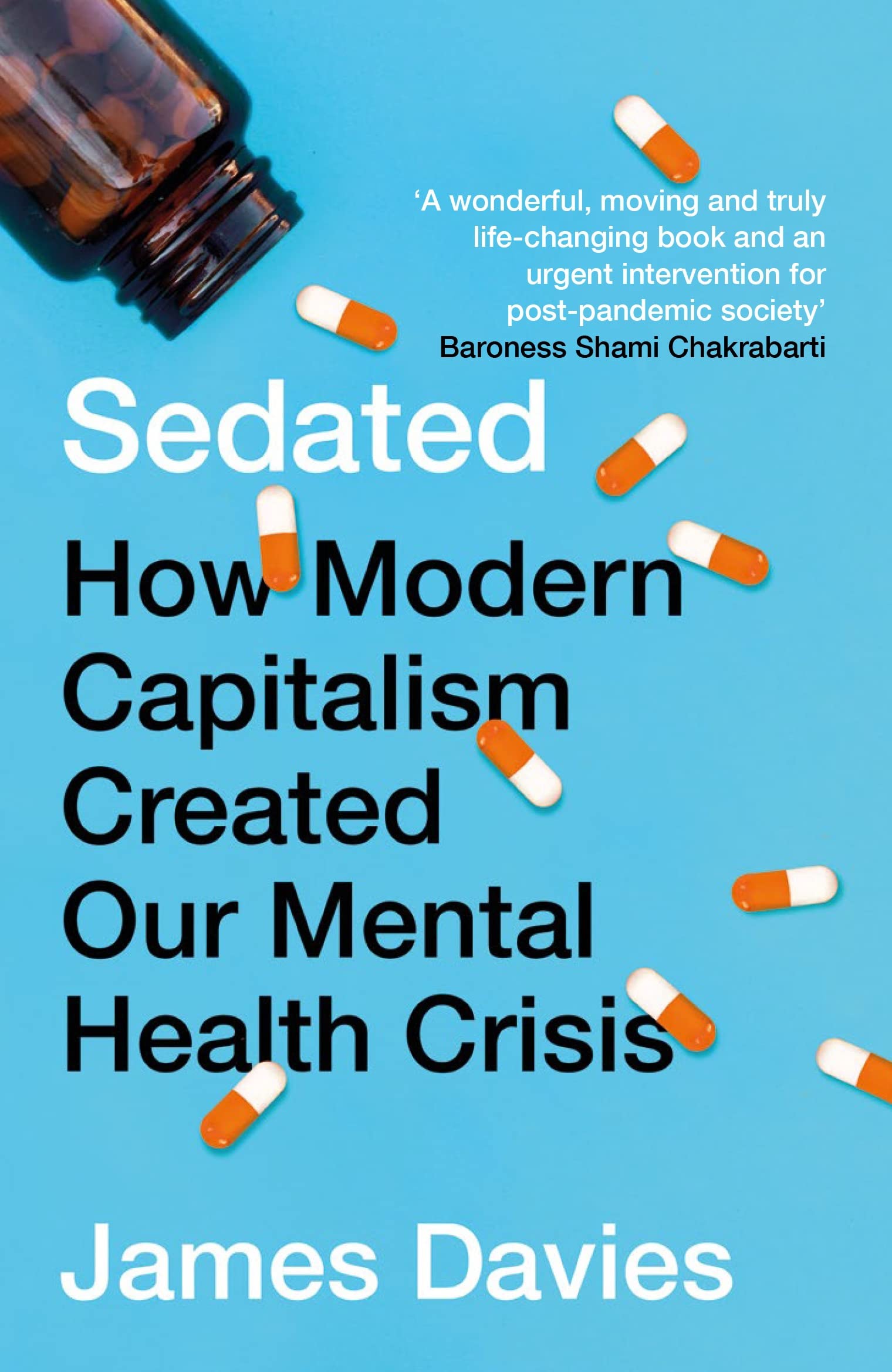
In his 2022 arresting book, Sedated: How Modern Capitalism Created Our Mental Health Crisis, James Davies demonstrates how Thatcher’s shift to neo-liberalism has brought about and perpetuated growing distress in the UK. Davies is an Oxford-trained medical and social anthropologist with expertise in drugs and a qualified psychotherapist. Through scientific sources, anecdotal experiences, and interviews, Davies argues that modern capitalism has made life unnecessarily harrowing. Workers face shrinking opportunities, longer hours, more temporary contracts, and stagnant wages. Students endure mounting pressure to excel whilst schools compete on the league tables. NHS trusts and private medical providers battle each other over limited government budgets. These systemic pressures have intensified the burden of daily life.
Cunningly, any signs of distress are condemned as personal deficiencies that require medication or interventions that target correcting individual thoughts and behaviours. Meanwhile, the deregulation of the pharmaceutical industry has enabled mass increases in prescriptions, despite limited and conflicting evidence, often tainted by poorly designed trials and financial conflicts of interest. Further, people’s suffering has become a lucrative market, where they are encouraged to consume, even at the expense of their financial health, to numb their pain. The modern economy creates distress and traps people in an endless cycle of living, suffering, being pathologised, consuming to cope, and continuing without resistance.
This book offers a compassionate perspective on the causes of human suffering. Rather than pointing fingers at the individuals for their negative emotions like many self-help books seem to do, Davies acknowledges that these feelings are completely, in his words, “understandable human responses to intolerable life events”.
He recounts working with Emma, a single mother whose ex-partner’s mother illegally reduced her custody time with her daughter, Mimi. This caused Emma severe depression and suicidal ideation. Only after the situation was resolved in court, with the support of a community solicitor and Davies, did Emma regain more frequent custody. Her mood then completely transformed: her depression lifted, her self-esteem and hope returned, and she began working towards her dreams.
This is one of many examples Davies uses to challenge the short-sighted practice of blaming the individuals for their suffering. Such distress, as he keenly observes from personal experience, most likely stems from “being engulfed by life’s difficulties or severe misfortunes”, rather than representing clinical illnesses requiring drugs or interventions that target changing individuals themselves. By highlighting structural problems underlying distress, Davies provides an alternative, holistic way of understanding human suffering and contributes to its de-stigmatisation.

This is not the first book attempting to raise awareness of the social and structural factors underlying mental distress. Yet, it is the first that dares to uncover the complex plan of an economic system designed to oppress and imprison citizens within the suffering it creates. It is a long-overdue indictment of the government, delineating its crimes against its citizens over the past several decades. The book serves as a wake-up call to citizens who have been sedated into a long-lasting dream induced by the system, urging them to take action and reclaim justice.
After a 389-page-long indictment, one would have expected concrete suggestions on how to help transform society and our lives. Sadly, this is not the case. Davies points out a bitter truth: “fundamental mental health reform is most likely to occur only once our political economy permits it”. Whilst I don’t disagree with this statement, it perpetuates the gloomy, helpless atmosphere that pervades the book.
Yet Davies himself notes, “no economic paradigm, after all, has ever existed in perpetuity”, and “when change arrives, and it will arrive, alternative ideas in the realm of mental health will only be poised for implementation if we keep putting in the effort right now”. Given this, I’d have loved to see him discuss what efforts we can make now to prepare for a more positive future – it’d have been a more complete and hopeful ending to a gloomy story.
Throughout the book, Davies continually juxtaposes the regulated capitalism that existed in the UK from the 1950s to the late 1970s with modern capitalism. He seems to assume that life before Margaret Thatcher was rosy and fantastic, and that returning to a state-controlled economic system would resolve ongoing problems. Perhaps this is partly true; after all, it was called The Golden Age of Capitalism.
Yet, it’s unwarranted to assume that people didn’t suffer from as much mental distress then as now. Psychology and psychiatry are relatively young fields. Our understanding of mental health has only recently improved, and there has been more awareness and attempts to seek diagnoses and treatment of mental illnesses after the 1970s than prior.
Moreover, regulated capitalism is neither sustainable nor entirely positive. History shows it resulted in the 1970s economic crisis and caused significant hardship. It wouldn’t be hard to imagine how distressing life must have been during those years – people got fed up and voted for Margaret Thatcher as Prime Minister after all. Therefore, any assumption that life is always on the greener side during the regulated capitalism era is unfounded.
Another issue is that perhaps Davies may be overly critical of psychiatric drugs. Whilst he provides extensive evidence that long-term use can worsen outcomes, this evidence primarily comes from observational or naturalistic studies, which are susceptible to biases, thereby weakening his argument. For example, he discusses a 2007 study by Harrow and Jobe showing that a higher percentage of schizophrenic patients who stopped drugs early achieved full recovery compared to those who continued.
However, this was a longitudinal observational study with no random assignment to drug usage groups. Random assignment is critical to ensure participants are similar enough that any outcome differences can be attributed solely to drug usage. Indeed, patients who stopped drugs had higher self-esteem and more frequent prior recovery periods than people who continued. These characteristics, rather than drug discontinuance itself, could have contributed to their recovery.
Other studies Davies cites also lack methodological rigour. Notably, a 2019 study by Hengartner received a formal critique for problematic methods. Several others lacked random assignment or showed signs of selection bias. Many of these studies were careful not to draw firm conclusions about the long-term adverse effects of psychiatric drugs. One even found the opposite – a 2017 study by Bockting and colleagues found better outcomes for patients who took drugs, then stopped and transitioned to cognitive therapy, compared to unmedicated patients. This raises questions about the validity of Davies’s claims regarding the adverse effects of psychiatric drugs. Whilst the over-prescription problem seems undeniable, this is no reason to condemn the genuine efficacy of psychiatric drugs, especially since they work for a subgroup of patients.
Finally, Davies’s discussion draws on evidence from anxiety, depression, and occasionally schizophrenia, yet fails to consider how modern society has contributed to people’s experience of other mental health problems that have also increased over time, such as eating disorders. Perhaps claiming that neo-liberalism has “created” all mental health crises is an overstatement. I’d have loved to see a more nuanced depiction of which crises he aims to address and how modern capitalism contributes to each.
Limitations aside, “Sedated” remains a captivating and valuable read, especially for those who agonise over the causes of their own or others’ suffering. Not all of Davies’s points will align with yours; however, it offers an alternative, compassionate perspective – one that follows a social justice agenda and requires zooming out to the bigger picture, to understand what you and others are experiencing.
