

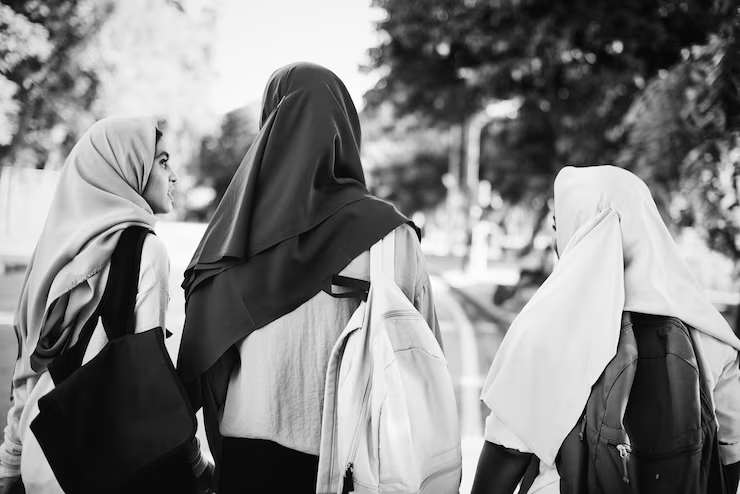
As I approach two months of living in the UK, I’ve begun to see what truly separates my old life in Sohag, a small, conservative city in Upper Egypt, from my new life in Brighton. It’s not just the language, the weather, or the food. It’s my body.
In Sohag, everything about being a woman is filtered through the body. The body is not yours; it belongs to the men in your family, your community, and, ultimately, to a moral system that defines honour through control. A woman’s body is ‘awrah’—something to be covered, silenced, and managed. From this belief, in many parts of the region, every form of violence I’ve known as an Arab woman finds its roots: female genital mutilation (FGM), child marriage, harassment, and even the prevention of travel. Each act is justified by the same cruel idea, that protecting my body means owning it.
At home, every day began and ended with surveillance. I had to watch what I wore even inside the house because my brother was there. My mother checked my sleeves, my neckline, and the tightness of my clothes. Makeup was unthinkable; lipstick could invite harassment. The hijab wasn’t a choice; it was an obligation. And when I stepped outside, the scrutiny multiplied. Every stare, every whisper, reminded me that I was being watched. The street was not mine; it belonged to the men who measured my worth with their eyes. In Sohag, femininity meant obedience, modesty, and submission, so safety was found in silence.
At home, every day began and ended with surveillance.
Then I moved to Brighton, and suddenly, silence wasn’t required anymore. No one cared what I wore. No one stared. I became invisible in the most liberating way. For the first time, I could wear bold lipstick colours without fear, walk alone without holding my breath, and feel the law standing on my side if someone crossed a line. When a man once told me, “Your jacket’s colour is really nice,” I smiled, not out of fear or discomfort, but because it was simple, human, and kind. There was no hidden threat.
Yet even here, freedom has layers. The body is still political, still symbolic. In Brighton, freedom is often measured by how you dress, how you identify, and how confidently you take up space. The battleground remains; it’s just that the rules have changed. In Sohag, the body was managed by silence; In Brighton, it speaks in art and in politics out in the streets.
I’ve realised that even when you travel far, your body remembers. It carries the memory of fear, of caution, of being watched. My shoulders still tense when I walk past a group of men. I still think twice before laughing loudly in public. The echoes of Sohag live inside my movements.
Where I come from, a woman’s body is never just a body; it’s a battleground, so everywhere, dancers are shamed for showing their bodies; women who cover their bodies are praised regardless of who they are or what they believe. On social media, women are insulted for their clothes, men are mocked for not “controlling” their wives or daughters, and headlines of murdered women fill our screens. When the body becomes the centre of every moral debate, what kind of life do we end up creating?
This obsession doesn’t just control women’s choices; it shapes their identities, relationships, and sense of self-worth. From a young age, girls are taught that their value lies in how much of their bodies they conceal or reveal, not in what they think or create. Even rebellion is framed through the body: removing the veil, posting a photo, dancing, or simply walking freely. The body becomes a battlefield for morality, politics, and power. And while society debates what women wear, it conveniently ignores that what women need is safety, freedom, and the right to exist without being reduced to flesh or fabric.
In Brighton, freedom is often measured by how you dress, how you identify, and how confidently you take up space. The battleground remains; it’s just that the rules have changed.
Perhaps that’s the journey I’m really on: learning to let my body speak after years of being told to hide it. And maybe, no matter where I go, the body remains the last homeland I carry with me.
Another article you may enjoy: https://thebadgeronline.com/2025/11/media-right-wing/
